--:--
What Is Corporate Transportation? The Complete Guide to Corporate Travel
Listen to article
Corporate transportation is the organized movement of employees, executives, clients, and event attendees using professionally managed, pre-arranged vehicle services — as distinct from personal vehicles, public transit, or on-demand rideshare apps. It covers everything from daily employee commuter shuttles and executive airport transfers to full fleet management for multi-day corporate conferences.
According to Mordor Intelligence, the global corporate employee transportation service market is valued at $42.37 billion in 2026 and is projected to reach $54.87 billion by 2031, registering a CAGR of 5.31% — driven by rising return-to-office mandates, hybrid work logistics, and growing demand for professional event transportation worldwide.
Price 4 Charter Buses & Limos has provided corporate transportation and employee shuttle services to Fortune 500 companies, federal agencies, and growing businesses nationwide since 2011. Our 24/7/365 reservation team is available at 866-265-5479 to build a custom solution for your organization.
In this guide, we’ll cover everything from what is corporate transportation and its measurable business benefits, to a step-by-step breakdown of how to plan routes, choose a vendor, and book the right vehicles for your workforce.
So, What is Corporate Transportation?
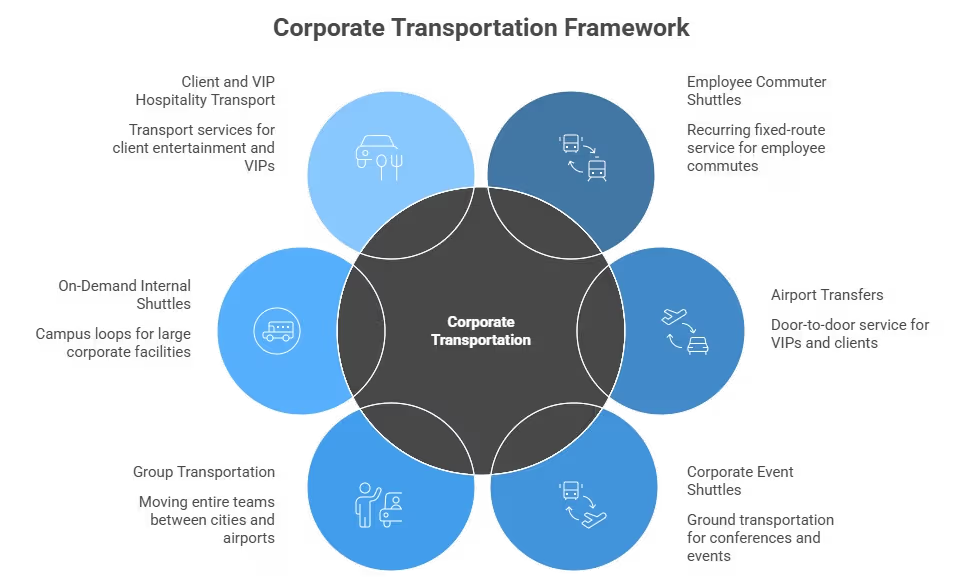
Corporate transportation refers to professional vehicle services arranged by a business to move its employees, executives, clients, or guests for work-related purposes. The defining characteristics that separate corporate transportation from a standard rideshare booking are pre-arrangement, private drivers, account-based management, and vehicles selected to match the scale and professionalism of the business use case.
The category is broad by design. Corporate transportation includes:
- Employee commuter shuttles: Recurring fixed-route service that picks up employees from transit hubs, neighborhoods, or park-and-ride lots and delivers them to the worksite on a predictable schedule
- Airport transfers: Door-to-door service for C-suite leaders, board members, VIP clients, and key talent arriving for high-stakes meetings
- Corporate event shuttles: One-time or multi-day ground transportation for conferences, conventions, team off-sites, and client entertainment events
- Group transportation for business travel: Moving an entire team — sales staff, engineers, trade show delegations — between cities, airports, and hotels
- On-demand internal shuttles: Campus or campus-to-campus loops at large corporate facilities, warehouses, or industrial parks with multiple buildings
- Client and VIP hospitality transport: Chauffeured service that makes a business impression on prospects, partners, or guests from the moment they arrive
What all these services share is a single requirement: reliability. In a business context, a late shuttle or a no-show vehicle is not an inconvenience — it is a direct cost in lost productivity, damaged client relationships, and broken schedules.
Why Corporate Transportation Is a Business Decision, Not a Perk
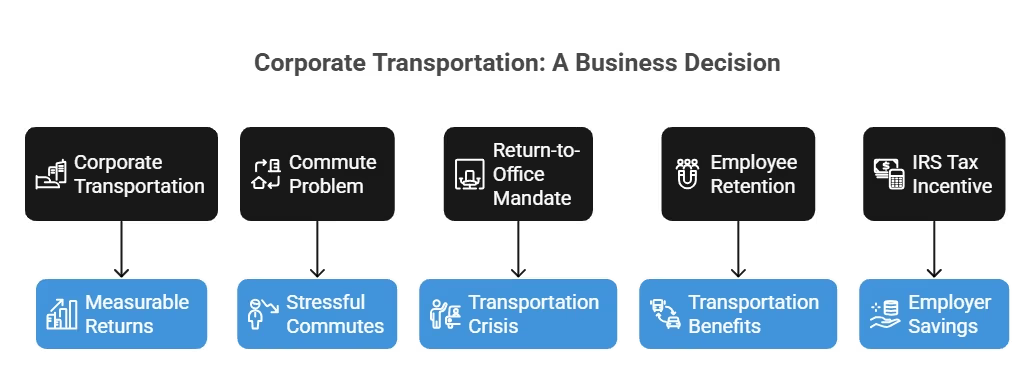
Corporate transportation is a business infrastructure investment with measurable returns in productivity, retention, and cost efficiency. The most common misconception is that a corporate shuttle is just a benefit companies offer to appear generous.
The data says otherwise — it is a business infrastructure investment with measurable returns in productivity, retention, and cost efficiency.
The Commute Problem Is Bigger Than Most Companies Realize
According to the U.S. Census Bureau's American Community Survey, the average American worker commuted 27.2 minutes each way in 2024 — nearly equivalent to pre-pandemic levels after a brief dip during remote work expansion. The New York Times reports that commute times have been rising steadily since 2006 and are now back to 2019 highs.
For organizations requiring return-to-office attendance, this creates a real friction point that affects both recruiting and day-to-day performance.
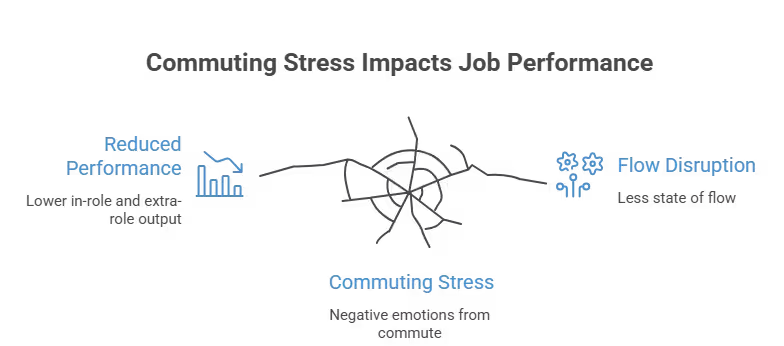
Peer-reviewed research published in Transportation Research Part F: Traffic Psychology and Behaviour (ScienceDirect, 2025) found that commuting stress negatively affects both in-role and extra-role job performance, with negative emotions acting as a mediator. The study — which collected data across three time waves from 340 full-time workers — found that employees who experience stressful commutes arrive emotionally depleted, producing measurably lower output.
Research in collaboration with WHU – Otto Beisheim School of Management found that aversive morning commutes directly reduce employees' state of flow — the highly productive cognitive state associated with peak performance.
The Return-to-Office Mandate Is Driving a Transportation Crisis
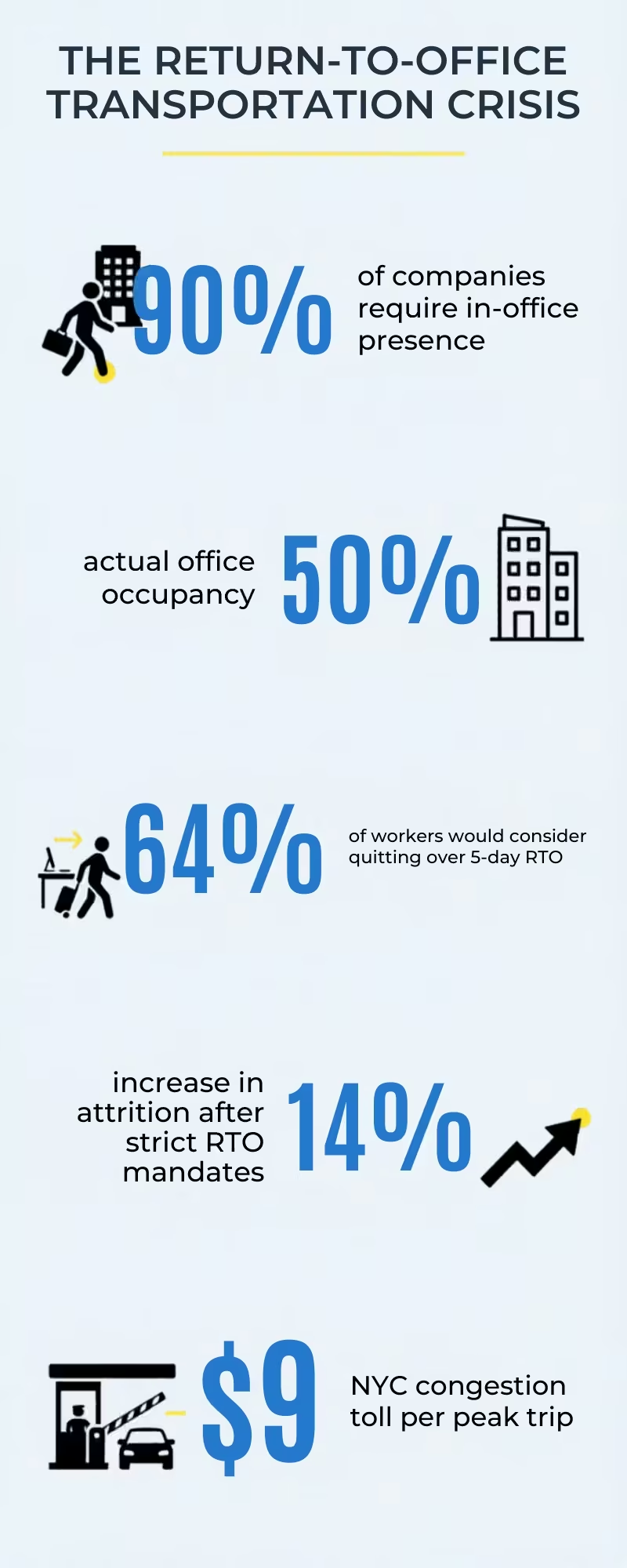
The return-to-office wave has made corporate transportation a mainstream business concern. According to Apollo Technical, 90% of companies required some form of in-office presence by the end of 2025, with major employers including Amazon, Google, and JPMorgan Chase requiring five-day in-person attendance. According to the Association for Commuter Transportation, 51% of corporate leaders want to boost office attendance further — yet office occupancy in most major markets remains at roughly 50% of pre-pandemic levels. The gap between what employers want and what employees experience largely traces back to commuting friction.
The stakes are high. Apollo Technical data shows that employee attrition rates increase by 14% following strict RTO mandates, and 64% of workers say they would consider quitting if forced back to the office full-time under a five-day policy.
Commuting cost is a central grievance: in New York City alone, congestion pricing implemented in January 2025 adds toll costs that vary by vehicle type, payment method, and time of day; for example, passenger cars and small commercial vehicles with a valid E-ZPass face a $9 peak toll. Employer-sponsored transportation absorbs these costs directly — reducing the financial burden that drives RTO resistance.
Employee Retention Is on the Line
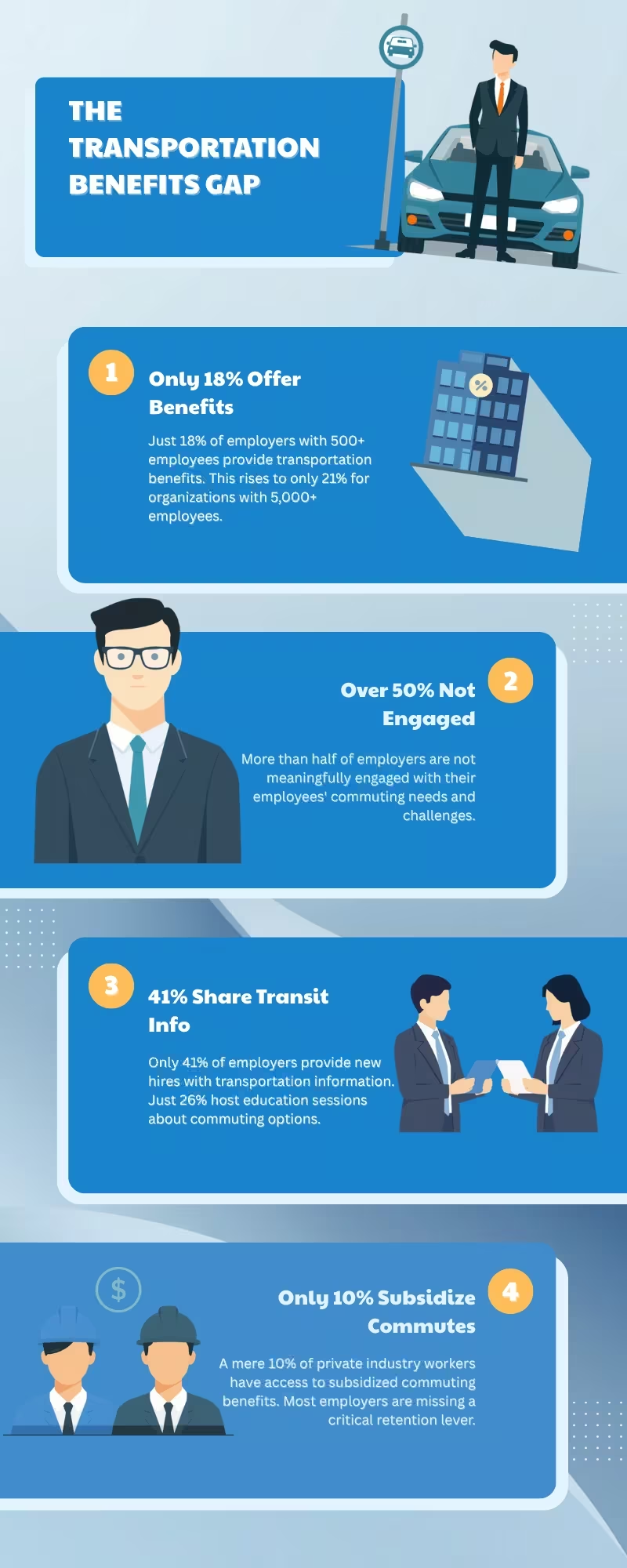
A Mercer survey of 721 employers found that 18% of employers with 500+ employees currently provide some form of transportation benefit or planned to in 2024 — rising to 21% for organizations with 5,000 or more employees.
According to Actionfigure and The 82 Alliance's national survey of employers, over half of employers are not meaningfully engaged with employee commutes despite using return-to-office mandates — a gap that directly drives the attrition problem. Among U.S. employees in organizations of 20 or more, only 41% said their employer provides new hires with transportation information, and only 26% said their employer hosts education sessions about commuting options.
The Bureau of Labor Statistics found that subsidized commuting was available to only 10% of private industry workers in 2024 — meaning the vast majority of employers are leaving one of the most effective retention levers completely untouched. The employers who act on transportation benefits first gain a structural recruiting advantage in markets where talent competition is highest.
The IRS Has Built a Tax Incentive Into the System
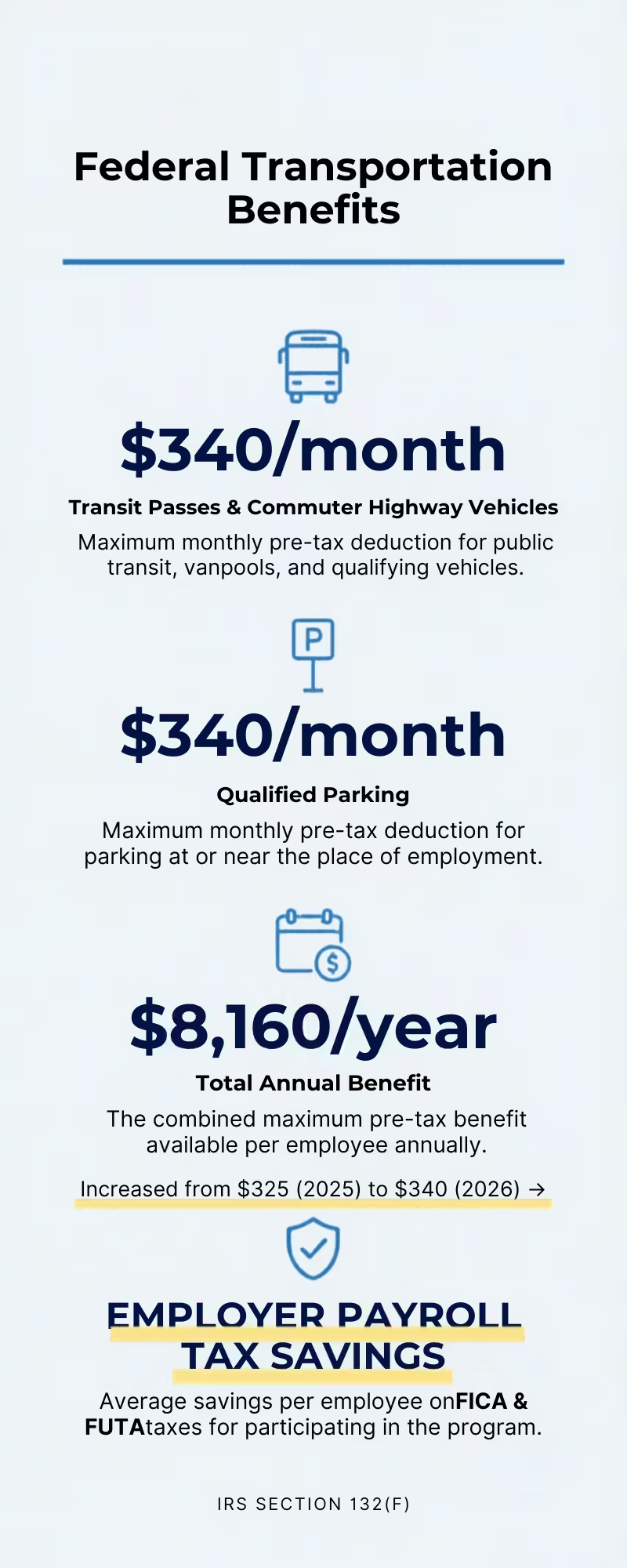
The federal government has recognized the value of employer-provided transportation through the IRS qualified transportation fringe benefit program under Internal Revenue Code Section 132(f).
For 2026, employees may exclude up to $340 per month on a pre-tax basis for transit passes and commuter highway vehicle costs, and an additional $340 per month for qualified parking — for a combined potential annual pre-tax benefit of $8,160 per employee.
Both employer-paid benefits and employee pre-tax salary deferrals count toward these limits.
According to Edenred and confirmed by IRS Publication 15-B, these limits increased from $325 in 2025 to $340 in 2026, reflecting ongoing cost-of-living adjustments.
Employers save on payroll taxes for every dollar run through the program.
The Different Types of Corporate Transportation
Let’s look at some of the many types of corporate transportation below.
1. Employee Commuter Shuttles
The most complex and highest-volume form of corporate transportation. Commuter shuttles run on fixed schedules, picking up employees from transit hubs — train stations, park-and-ride lots, dense residential areas — and delivering them to the worksite.
The ROI case is clear: research via the State Smart Transportation Initiative shows that predictable, employer-managed commutes reduce the emotional exhaustion that depresses daily productivity.
Commuter shuttles are particularly valuable for:
- Corporate campuses in suburban or industrial locations with limited public transit coverage
- Facilities with shift-based workforces requiring early-morning or late-night pickups (warehouses, manufacturing plants, data centers, hospitals)
- Companies competing for talent in metro areas where parking is prohibitively expensive or unavailable
- Organizations with sustainability goals seeking to reduce single-occupancy vehicle commutes under Scope 3 emissions reporting
2. Airport Transfers
An airport transfer ensures that a C-suite leader, key client, or board member is picked up at the terminal by a driver in a pre-arranged, clean vehicle — with no waiting, no navigation friction, and no uncertainty about cost.
This is the category where corporate transportation most directly functions as a brand signal: the quality of the vehicle and driver communicates your organization's standards before a single meeting begins.
Key operational requirements for executive transfers:
- Real-time flight tracking to adjust pickup times for early arrivals, delays, or gate changes
- Pre-arranged driver cell number shared before the flight departs
- Meet-and-greet service at baggage claim, not curbside only
- Vehicle class appropriate to the passenger — executive sedan for solo travelers, minibus for delegations
- Zero surge pricing — the fare is locked when the booking is made
3. Corporate Event Transportation
Any gathering that brings employees, clients, or partners to a common location creates a transportation logistics problem.
Corporate event transportation includes: airport-to-hotel shuttles for multi-day conferences, hotel-to-venue runs for dinner events and award ceremonies, charter buses for team off-sites and incentive trips, and late-night return shuttles after events where alcohol is served.
The scale varies dramatically — from a 15-passenger sprinter van moving a board of directors to a fleet of five 56-passenger motorcoaches moving 250 sales conference attendees between an airport, a hotel, and a convention center on staggered schedules.
The planning principles are the same regardless of scale: build the transportation plan before the venue is finalized, account for peak-hour traffic in your schedule, and never rely on rideshare availability as a fallback for a group of more than 10 people.
If you never rented transportation before, our charter bus rental guide is a great piece for you to review.
4. Conference and Convention Shuttle Service
A specialized subset of corporate event transportation, conference shuttles require multi-day scheduling across multiple hotels, a central convention venue, and often satellite event locations. The key operational challenge is that attendees are arriving from different hotels on different schedules — requiring either fixed-interval loops or a dispatch-based system with centralized coordination.
According to the FTA Major Event Playbook on event transportation, transit agencies are encouraged to use supplemental public transportation and charter-style services—such as structured shuttle operations—to move large crowds efficiently to and from major event venues.
By shifting trips from personal vehicles to coordinated shuttle services, agencies can help reduce traffic congestion, improve reliability of arrivals, and lessen pressure on on-site parking resources at host venues.
For overnight or multi-day movements, a good read is this charter bus packing guide, especially when teams are traveling with luggage, sales materials, or event equipment.
For event organizers, this typically results in fewer transportation-related complaints, smoother venue operations, and a stronger first impression for attendees.
5. Group Business Travel
When a team needs to travel together — to a trade show, a client site, an offsite training, or a multi-city road trip — corporate group transportation replaces the friction of coordinating individual flights, rental cars, and rideshares into a single managed vehicle.
A 56-passenger charter bus for a 40-person sales team is almost always cheaper per person than individual airline tickets, significantly less logistically complex, and allows the team to work, brief, or debrief during transit.
Key uses include: trade show and convention travel, athletic team travel, corporate retreat and incentive trip logistics, and client entertainment including sporting events, concerts, and hospitality events.
6. On-Campus and Last-Mile Shuttles
Large corporate campuses — tech parks, university medical centers, manufacturing complexes, airport employee facilities — often require internal shuttle loops connecting parking structures, multiple buildings, transit stops, and amenity locations. This category also covers "last mile" transportation: the connection between a public transit stop and a corporate facility that is otherwise inaccessible without a car.
According to U.S. Census Bureau commuting mode data, only 3.7% of American workers use public transit to commute, in part because last-mile gaps make many employment sites effectively unreachable without a car. A corporate last-mile shuttle solves this directly — expanding the geographic hiring radius and making the worksite accessible to workers who cannot afford a car or do not drive.
Corporate Transportation Vehicle Types
Price 4 Charter Buses & Limos has a nationwide fleet of over 12,000 vehicles covering every vehicle class used in corporate transportation including limousines, party buses, charter buses, minibuses, shuttle buses, school buses and sedans/SUVs.
In our experience, we know that matching the right vehicle to the trip type is more than important, it’s everything.
According to Mordor Intelligence market data, buses and coaches contributed 42.37% of 2025 corporate transportation revenue, while vans and MPVs are projected to grow at a 5.37% CAGR — reflecting the ongoing diversification of vehicle classes used in professional commuter and event programs.
| Vehicle Type | Passenger Capacity | Typical Corporate Use | Average Hourly Cost ($) |
|---|---|---|---|
| Sedan / Stretch Limo | 6–12 passengers | VIP client pickups, executive hospitality, awards dinners, premium airport transfers | $160–$300+/hr |
| SUV Limo | 12–20 passengers | Senior leadership arrivals, group client entertainment, premium event transportation | $200–$400+/hr |
| Sprinter Van Rental With Driver | 8–15 passengers | Small team airport transfers, executive group moves, corporate event arrivals | $150–$450/hr |
| Small Party Bus | 10–20 passengers | Team celebrations, client entertainment, convention after-parties | $180–$450+/hr |
| Minibus | 15–18 passengers | Commuter feeder routes, small office shuttles, hotel transfers | $150–$430+/hr |
| Minibus | 20–24 passengers | Small conference groups, office loops, airport-hotel transfers | $150–$440+/hr |
| Minibus / Mini Coach | 25–35 passengers | Mid-size conference shuttles, multi-hotel loops, campus transportation | $150–$450+/hr |
| Medium Party Bus | 20–40 passengers | Larger employee outings, private company celebrations, multi-stop nightlife events | $200–$500+/hr |
| Large Party Bus | 40–50 passengers | Big team celebrations, branded group nights out, large hospitality events | $250–$500+/hr |
| Standard Charter Bus / Motorcoach | 50–56 passengers | Full-size conference shuttles, large employee commuter routes, major event transportation | $180–$500+/hr |
| Entertainer Coach / Specialty Coach | Not stated on pricing page | High-end specialty transport, touring-style executive travel, premium hospitality moves | $315–$550+/hr |
These are published Price4Limo pricing examples. Actual pricing varies by city, day of week, season, trip length, routing, vehicle availability, and amenities.
Price 4 Charter Buses & Limos offers these vehicles and more all throughout the United States. For specific packages — call 866-265-5479 to confirm fleet specs for your program.
The Business Case: Corporate Transportation vs. Rideshare Stipends
Many organizations default to rideshare reimbursement — giving employees a monthly Lyft or Uber stipend — because it appears lower in upfront cost and eliminates the operational complexity of managing a shuttle program.
The math does not hold up at scale.
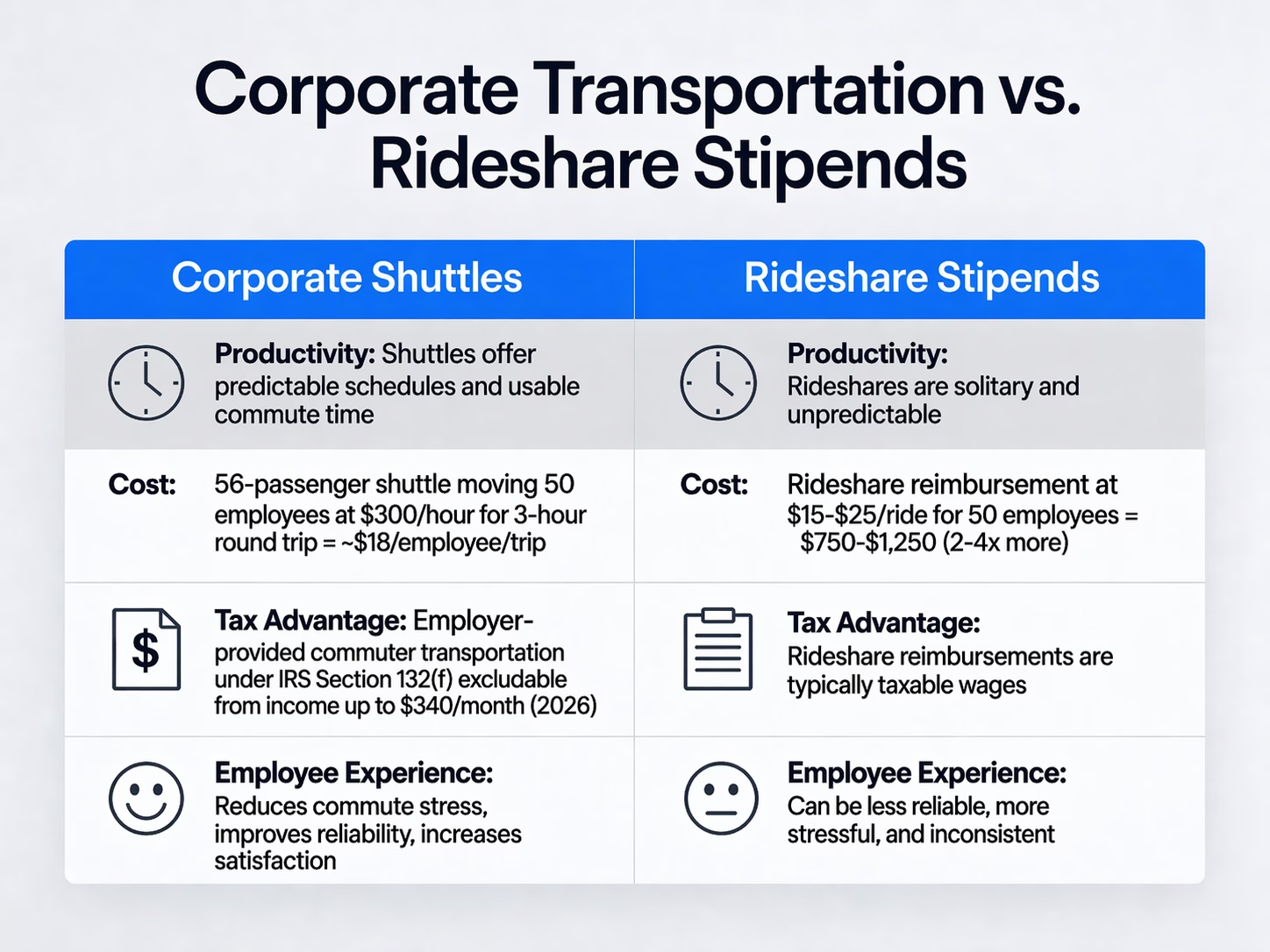
The productivity argument: Rideshare rides are solitary, unpredictable in timing, and subject to surge pricing that makes budgeting unreliable. A corporate shuttle operates on a fixed schedule — employees know exactly when they arrive — and ride time can be used productively (laptop work, briefings, decompression). The ScienceDirect research on commuting stress and job performance found that the predictability of a commute is as important as its duration in determining its impact on daily performance. Employer-run shuttles reduce uncertainty — predictable ETAs, reliable headways — which directly dents the stress pathway that depresses work output.
The cost argument: A 56-passenger motorcoach moving 50 employees at $300/hr for a 3-hour round trip costs $18 per employee per trip. A rideshare reimbursement for the same 50 employees at $15–$25 per ride each way would total $1,500–$2,500 round trip — still materially higher than the $900 charter cost, without the productivity, reliability, or sustainability benefits.
The tax argument:IRS Section 132(f) explicitly excludes employer-provided commuter transportation in a qualifying van or commuter highway vehicle from employee income up to $340/month in 2026. Rideshare reimbursements, in contrast, are typically treated as taxable wages. The tax structure is specifically designed to incentivize organized commuter transportation over individual vehicle use — meaning the IRS is, in effect, subsidizing corporate shuttle programs at a rate unavailable to ad-hoc rideshare reimbursements.
The engagement argument: According to Actionfigure's national employer commuting survey, only one in six employers provides the education, information, and human resources to meaningfully support employee commutes — yet research in transportation demand management consistently shows these investments reduce total commuting cost and increase employee satisfaction. Providing a shuttle is the highest-impact single action an employer can take in this space.
How to Plan Corporate Transportation
Planning corporate transportation involves defining group size, scheduling, and vehicle needs in advance to secure options like shuttles, Sprinter vans, or sedans.
Key steps include identifying critical arrival times, booking reliable vendors early, preparing contingency plans for delays, and providing clear, detailed itineraries for a seamless attendee experience.
The principles that experienced event planners apply consistently:
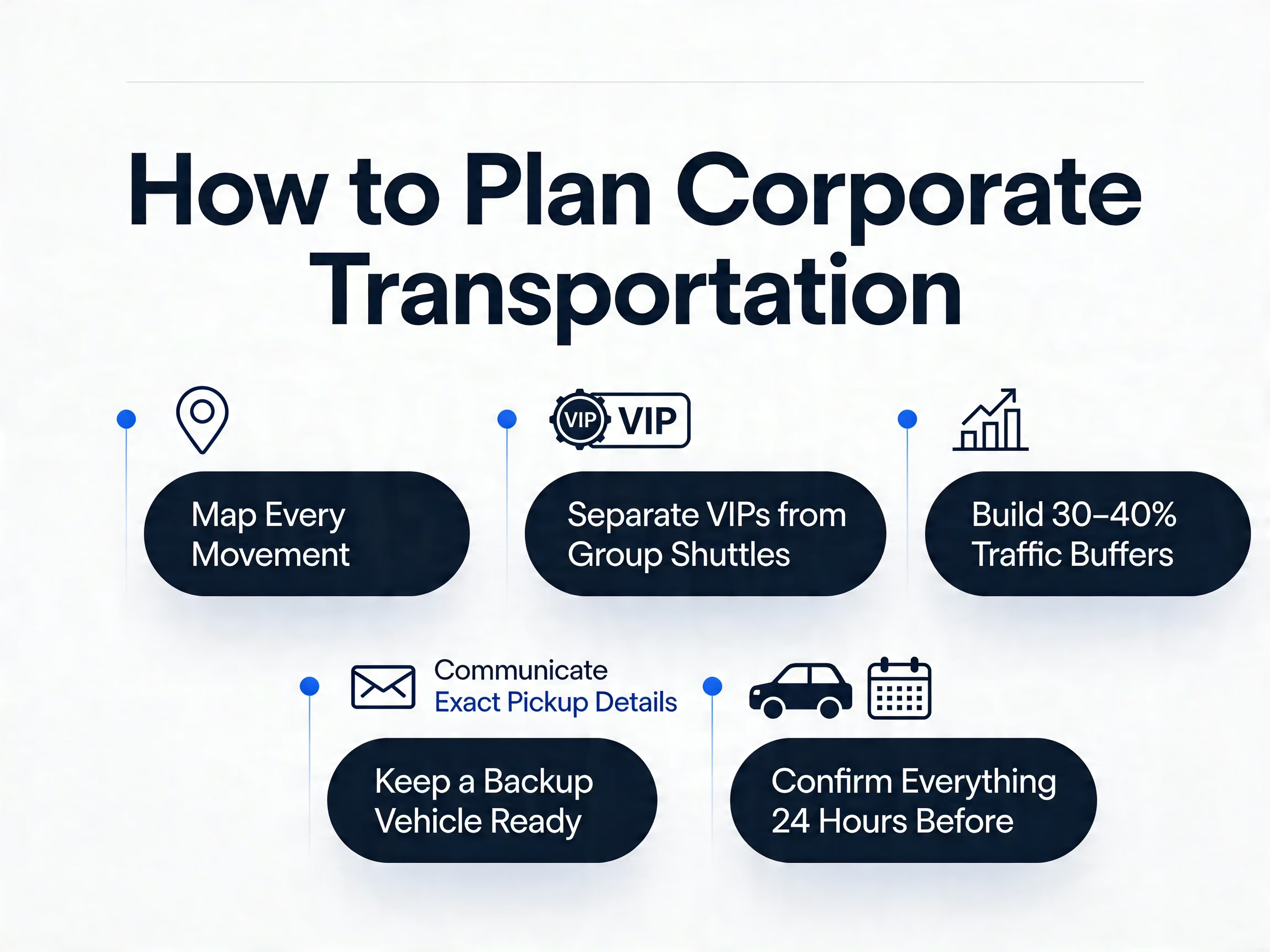
Step 1: Map Every Movement Before Selecting a Vehicle
Start with a complete movement manifest: where every attendee is coming from (hotel name and exact address), where they need to go, in what order, and at what times. Identify the single most time-critical departure in your schedule — usually the first morning session start time — and build every other wave backward from there.
Step 2: Separate VIP Movements from Group Shuttles
Executive presenters, keynote speakers, board members, and major clients should never be consolidated with general attendee shuttle loops.
Their schedules are less predictable, their vehicles should be higher quality, and a delay in their arrival has a disproportionate impact on the event. Book a dedicated vehicle for VIP movements — even if it runs fewer passengers per trip.
Step 3: Build Real Traffic Buffers into Every Run
According to U.S. DOT transit planning guidance, peak-hour urban transportation planning must account for significant travel time variance.
A 20-minute hotel-to-venue run at 9:00 AM on a clear Wednesday can take 45 minutes on a Thursday morning when the downtown convention center has three concurrent events.
Build 30–40% traffic buffer into every scheduled corporate event run.
Never use a Google Maps car-route estimate to calculate a bus schedule.
Step 4: Communicate Like a Logistics Operation
Every attendee needs to know: the exact pickup location (building entrance number, not just hotel name), the exact departure time, and the direct phone number of the transportation coordinator on the ground.
For conferences with 200+ attendees, a dedicated transportation desk near the hotel lobby entrance with a staff member present from the first pickup wave eliminates the confusion that causes missed buses.
Step 5: Have a Contingency Vehicle on Standby
For events where a transportation failure directly impacts business outcomes — client conferences, investor days, executive retreats — a standby vehicle is cost-effective insurance.
A vehicle sitting idle for four hours costs far less than the reputational damage of 30 executives waiting on a curb because the primary bus broke down.
Step 6: Confirm the Day Before
Call your transportation vendor 24 hours before the event to confirm: driver names and cell numbers, all pickup addresses and sequences, any venue access restrictions, and the contact for your on-site transportation coordinator.
Put every confirmed detail in writing. Issues discovered the morning of an event take 10x longer to resolve than the same issue surfaced the day before.
While Price 4 Charter Buses & Limos has a specialized confirmation department that calls to verify details, performing a final check 24 hours prior prevents last-minute surprises.
Corporate Transportation and the Hybrid Work Model
The rise of hybrid work has fundamentally changed the nature of corporate commuting — and created new transportation logistics challenges that didn't exist in a fully in-person environment.
According to Deloitte Insights, the share of paid days worked remotely rose from 7.2% in 2019 to 27.7% in 2024.
According to Founder Reports, as of March 2026, 22.6% of U.S. employees work remotely at least partially — and 53.1% of those who work from home at least sometimes are in hybrid roles rather than fully remote.
This creates a non-obvious demand pattern for corporate transportation.
In a fully in-person environment, shuttle ridership is predictable: the same 200 employees on Monday through Friday.
In a hybrid environment, ridership fluctuates by day of week — with Tuesday through Thursday typically at peak demand and Monday and Friday at 40–60% of that level.
Transportation vendors and HR teams that build fixed-capacity shuttle contracts around peak-day ridership will systematically over-pay on low-occupancy days.
The solution is flexible contract structures — week-by-week ridership reporting, vehicles that can scale up or down by capacity based on confirmed reservations, and route designs that consolidate lower-demand days onto smaller vehicles.
Mordor Intelligence notes that rentals and leasing — 3- to 12-month flexible contracts — are growing at a 5.33% CAGR precisely because hybrid work has made the 3-year fixed fleet contract obsolete for most organizations.
The market is shifting toward outsourced, asset-light models that convert fleet depreciation into variable service expense.
ESG, Sustainability, and Corporate Transportation
Corporate transportation is increasingly a core ESG (Environmental, Social, and Governance) metric — not just a logistics function.
Transportation accounts for roughly 20–25% of global CO2 emissions, according to international energy and climate data, making it one of the largest sectors organizations can influence through employee commuting programs.
The business case for greener corporate transportation is no longer just reputational.
Electric and low-emission vehicles can significantly reduce per-vehicle emissions compared to traditional gas-powered fleets, particularly in high-occupancy use cases like employee shuttle programs.
The U.S. transportation sector accounts for approximately 30% of energy-related emissions nationally — making fleet electrification one of the highest-leverage sustainability actions an employer can take.
For organizations with formal ESG commitments, a corporate shuttle program accomplishes multiple objectives simultaneously:
- Scope 3 emissions reduction: When multiple employees share a single vehicle, the per-person emissions drop substantially compared to single-occupancy commuting, especially at higher vehicle occupancy rates
- ESG reporting data: Shuttle programs generate ridership, route, and emissions data that integrates directly into sustainability reports
- Talent attraction: According to ADEME research cited by Go-Electra, 65% of workers value their employer's environmental commitments — making a visible green transportation program a talent acquisition signal
- Regulatory compliance: Zero-emission zones are expanding in U.S. and European cities; organizations that have already transitioned shuttle fleets to EV have no disruption cost when these mandates take effect
Call Price 4 Charter Buses & Limos 866-265-5479 to ask about EV-equipped vehicles and sustainable fleet options in your market.
Technology and Corporate Transportation Management
Modern corporate transportation programs are managed through integrated technology platforms — not phone calls and spreadsheets. Understanding the technology layer helps organizations evaluate vendors, measure program performance, and optimize routes and costs over time.
GPS Fleet Tracking and Real-Time Visibility
According to fleet management research, GPS in commercial fleets has evolved from simple location tracking to advanced telematics — combining GPS, onboard diagnostics, sensor data, and wireless connectivity into a single continuous data stream. Real-time tracking provides three direct benefits for corporate clients: transparency (you know exactly where your vehicle is and when it will arrive), accountability (driver behavior and route adherence are documented), and incident response (if a vehicle is delayed or diverted, the operations team knows immediately).
Fleet tracking platforms can provide real-time vehicle visibility, routing support, and dispatch coordination for larger transportation programs.
Route Optimization and AI-Powered Scheduling
Transportation management systems (TMS) with AI-powered routing deliver measurable efficiency gains.
Transportation management systems can help corporate shuttle programs improve route planning, reduce unnecessary mileage, and make it easier to match vehicle capacity to actual ridership. For multi-route commuter programs, that can mean better schedule visibility, less manual coordination, and more efficient day-to-day operations.
For multi-route corporate commuter programs with dozens of pickup points, AI routing reduces dead miles and finds the optimal stop sequence that minimizes total travel time per passenger.
Ridership Tracking and HR Integration
For ongoing commuter programs, ridership data is a business asset. Tracking which employees use the shuttle on which days, which stops have the highest demand, and how utilization fluctuates by day of week gives HR and facilities teams the data to right-size their vehicle contracts month over month.
The best corporate transportation vendors provide regular ridership reporting as a standard account service.
Ask any vendor you evaluate: "What reporting can you provide on ridership, on-time performance, and utilization by route?"
IRS Tax Treatment of Corporate Transportation Benefits
The IRS qualified transportation fringe benefit program is one of the most underutilized cost-saving tools in corporate HR.
Under Internal Revenue Code Section 132(f), employers can provide transportation benefits to employees on a tax-free basis — reducing payroll taxes for the employer and reducing taxable income for the employee simultaneously.
The 2026 limits, per IRS Publication 15-B:
| Benefit Type | 2026 Monthly Limit | Annual Value per Employee |
|---|---|---|
| Transit passes / commuter highway vehicle | $340/month | Up to $4,080/year |
| Qualified parking | $340/month | Up to $4,080/year |
| Combined maximum | $680/month | Up to $8,160/year |
According to Thomson Reuters, these limits have been steadily increasing with inflation — rising from $315 in 2024 to $325 in 2025 to $340 in 2026. For a company with 200 employees using the full transit benefit at $340/month, that is $816,000 in annual pre-tax compensation flowing through the payroll tax exemption — a direct bottom-line benefit to both employer and employee.
Corporate transportation costs for legitimate business purposes are also generally deductible as an ordinary and necessary business expense
How to Evaluate and Choose a Corporate Transportation Vendor
Evaluating and choosing a corporate transportation vendor requires assessing company history, reliability, and service customization. Prioritize providers, like Price 4 Charter Buses & Limos, with strong industry experience, modern, varied fleets, and experience.
The criteria that matter:
Fleet Size and Geographic Reach
A vendor with a single-city fleet cannot serve your needs if your corporate events span multiple markets.
We offer charter bus services across the United States covering all major and minor cities.
Account Management and 24/7 Support
Corporate transportation runs outside business hours — early-morning airport pickups, late-night conference returns, early Saturday flights.
Ask for the direct line of the account manager and the after-hours emergency dispatch number before signing any contract.
Contract Transparency
Confirm in writing: minimum hours and how standby time is billed, overtime rate and billing increment (15-minute vs. 30-minute), gratuity inclusion, vehicle substitution policy, cancellation terms, and insurance minimums.
A vendor that resists providing clear written answers on any of these points before signing is a vendor worth avoiding.
Technology and Reporting
For ongoing commuter shuttle programs, look for vendors that can provide route optimization reporting, ridership tracking, on-time performance data, and integration with HR or expense management systems.
These tools transform a transportation program from an opaque line item into a measurable operational asset with documented ROI.
Industry-Specific Corporate Transportation Use Cases
Corporate transportation needs are not one-size-fits-all.
Different industries have distinct operational requirements, regulatory constraints, and employee demographics that shape how transportation programs are built.
Healthcare and Hospital Systems
Hospital systems operate 24/7 across multiple shift patterns — including 6:00 AM, 7:00 AM, 11:00 PM, and 3:00 AM shift transitions that fall outside public transit operating hours. Employee parking is often limited and expensive at urban medical campuses.
A corporate shuttle program that serves nursing staff, support workers, and administrative employees across multiple shift changes reduces late arrivals, improves workforce reliability, and expands the hiring radius — all critical in a sector facing chronic labor shortages.
ADA compliance is non-negotiable in healthcare shuttle programs, as a significant proportion of medical professionals and patients may require mobility-accessible vehicles.
Manufacturing and Warehousing
Industrial facilities located outside urban centers face the most acute last-mile transportation challenge: their workers often don't own cars, public transit doesn't serve the facility, and rideshare drivers don't operate in industrial zones at 5:00 AM.
A dedicated shuttle program broke that bottleneck. For warehousing and manufacturing operations, transportation is often the difference between hitting and missing labor headcount targets.
Financial Services and Professional Services
Banks, law firms, consulting firms, and investment managers operate in dense urban CBDs where parking is $20–$40/day per vehicle and congestion pricing adds additional costs for drivers. Executive transportation is a standard operating expense for client-facing professionals who travel between offices, courthouses, deal venues, and airports multiple times per week.
The brand signal of a properly executed ground transportation program is not lost on clients who expect a certain standard of service. For multi-city roadshows — investor days, pitch tours, board presentations — seamless ground transportation logistics in every city is an operational requirement, not a nice-to-have.
Technology Companies
Tech campuses pioneered the modern corporate shuttle model — Google, Apple, and Meta all operate large, sophisticated employee shuttle programs that are now industry benchmarks.
For tech companies in suburban campus locations (Silicon Valley, Research Triangle, Austin's Domain), shuttle programs have long served as both a functional commuter solution and a differentiated recruiting benefit. As hybrid work has reduced average weekly ridership, the focus has shifted from fixed commuter routes to on-demand and flexible route structures that adapt to Tuesday-Thursday peak attendance patterns.
The highest-performing tech company shuttle programs now integrate ridership reservation systems that allow employees to confirm their commute 24–48 hours in advance, enabling right-sizing of the vehicle dispatch each day.
Construction and Field Operations
Project-based industries where workers need to travel from a central staging area to construction sites, field locations, or remote project sites have a transportation need that is fundamentally different from a fixed-campus commuter shuttle.
Vehicle selection here prioritizes durability, loading capacity for equipment and personal protective equipment, and the ability to handle non-urban road conditions.
How Price 4 Charter Buses & Limos Delivers Corporate Transportation
After 15 years and 50,000+ trips, our corporate transportation team has solved logistics challenges that matter to actual businesses. Here is how that experience shows up in practice:
The Fortune 500 sales conference in Chicago: 340 attendees, three hotels, one convention center, a welcome dinner at a separate venue, and a closing night event 45 minutes away. We fielded a fleet of eight 56-passenger motorcoaches running on overlapping schedules across a 3-day program. Every movement was within three minutes of schedule. The event operations director told us it was the first year they didn't receive a single transportation complaint from attendees.
The tech campus last-mile shuttle in Austin: A growing software company with a campus in a suburban office park, 6 miles from the nearest Metro Rail station. Their recruiting team was losing candidates who couldn't commute without a car. We set up a fixed-route shuttle running three times per morning and three times per evening, six days a week. Within one hiring cycle, their candidate acceptance rate improved because the transportation option removed a top objection.
The five-day convention shuttle service for a 10,000-guest IPO event in Nashville: A company planning a major multi-day IPO convention needed a transportation system that could move thousands of attendees between hotels, the convention venue, airport arrivals, private dinners, and off-site events without bottlenecks. We rebuilt the ground plan around staggered hotel loops, tiered vehicle assignments, and wave-based departures, replacing a one-size-fits-all bus schedule with a mixed fleet of full-size charter buses, minibuses, and executive sprinters matched to each route’s actual demand. We also introduced a live manifest and dispatch structure so loads could be adjusted by day, by event block, and by VIP priority. The result was a smoother five-day operation, faster loading windows, fewer empty seats, and a transportation program built to handle Nashville at full convention pace.
Call 866-265-5479 and describe your corporate transportation need — we'll have a solution and a quote in under 30 seconds.
Corporate Transportation Pricing & Costs: What to Budget
Corporate transportation costs are calculated differently depending on the service type:
Commuter shuttle programs: Priced on a contract basis — daily, weekly, or monthly — with routes, vehicle sizes, and schedules defined upfront. Typical cost per employee per trip ranges from $3–$10 depending on vehicle size, route length, and ridership. Monthly program contracts typically range from $8,000–$25,000+ depending on fleet size and route complexity.
The most accurate way to budget your corporate transportation program is to call our reservation team at 866-265-5479 with your city, your headcount, your schedule, and your event type. We’ll build a flat-rate quote with full line-item transparency in under two minutes.
Need pricing for your corporate transportation program?
Share your city, headcount, trip type, and schedule. Our reservation team can build a custom quote for employee shuttles, airport transfers, executive moves, or corporate event transportation.
Common Corporate Transportation Mistakes
Using rideshare for groups larger than 10: At 15+ people, the operational complexity and cost of coordinating individual rideshare pickups exceeds a charter vehicle on every dimension — cost, punctuality, and productivity.
Not accounting for traffic in schedule building: A hotel-to-venue run that takes 20 minutes at 2:00 PM takes 45 minutes at 8:30 AM during a downtown convention. According to U.S. Census Bureau ACS commute data, average commute times are rising in major metro areas — your event schedule needs to reflect rush-hour reality, not off-peak assumptions.
Booking too late: For large conferences and multi-day programs, top-tier transportation vendors in major markets can be fully committed months in advance. Book corporate event transportation at the same time you book your venue.
Skipping the standby contingency vehicle: For business-critical events, the cost of a standby vehicle is trivial compared to the reputational and financial cost of a transportation failure in front of clients or executives.
Ignoring hybrid work ridership variability: Fixed shuttle contracts built for five-day weekly ridership will over-provision — and over-spend — in a three-day hybrid environment. Right-size your contract to Tuesday–Thursday peak demand, not theoretical full-week capacity.
Treating vendor selection as a commodity purchase: Not all transportation companies are created equal. Lowest-price selection without due diligence is the most common source of event-day transportation failures. Going with a company like Price 4 Charter Buses & Limos ensured a 96% customer satisfaction rate, backed by over 4,000 verified five-star reviews and 15+ years of transportation expertise.
Frequently Asked Questions About Corporate Transportation
- What is the difference between corporate transportation and rideshare?
Corporate transportation offers professional chauffeurs, pre-booked scheduling, and premium vehicles with fixed, flat-rate pricing for high reliability and comfort. Rideshare (e.g., Uber/Lyft) provides on-demand, cost-effective transport using personal vehicles, but involves surge pricing, potential cancellations, and variable service quality.
- Do I need corporate transportation if we already provide a parking stipend?
Parking stipends address a different problem — they subsidize the cost of driving, not the friction of commuting. They also do not reduce per-employee transportation cost at scale, and they do not generate the productivity benefit of a predictable, reliable shuttle. Under IRS Section 132(f), both qualified parking and commuter transit benefits can be offered simultaneously up to $340/month each — they are complementary, not competing.
- How many employees do I need before a shuttle program makes sense?
As a rule of thumb, a commuter shuttle program becomes economically competitive with individual rideshare reimbursements at 20 or more employees traveling a similar route. Below that threshold, transit pass benefits or vanpool programs are typically more efficient. Above 50 employees on a common route, a dedicated shuttle almost always wins on cost, reliability, and productivity.
- Can Price 4 Charter Buses & Limos handle multi-city corporate programs?
Yes. Our nationwide fleet of 12,000+ vehicles allows us to coordinate transportation in every major U.S. market through a single account management team. We have served Fortune 500 companies, federal agencies, and major conferences across multiple cities simultaneously — with a single point of contact managing all logistics. Call 866-265-5479 to discuss your multi-market needs.
- What is required to set up an ongoing corporate shuttle contract?
We need your route(s), your pickup and drop-off locations, your required schedule (days, times, frequency), your expected ridership, and any vehicle-specific requirements (ADA lift, WiFi, luggage storage). From those inputs, we build a route plan and flat-rate pricing proposal. Most corporate shuttle contracts can be executed and operational within two to three weeks.
- What sustainability benefits can we get from a corporate shuttle program?
Corporate shuttle programs offer significant sustainability benefits by consolidating individual commutes into shared transport, typically reducing carbon emissions by replacing 10–50 private cars with a single vehicle. These programs directly lower Scope 3 greenhouse gas emissions, improve regional air quality, alleviate traffic congestion, and allow companies to reduce on-site parking infrastructure in favor of green spaces.
- What happens if our headcount changes mid-contract?
Our team adjusts vehicle sizes, route frequency, and schedules as your workforce changes. Corporate commuter contracts should include explicit provisions for mid-contract adjustments — confirming the timeline for adding or removing vehicles, the pricing impact of route changes, and any notification requirements. Call 866-265-5479 to discuss the contract flexibility built into our corporate programs.
Why Employers Choose Price 4 Charter Buses & Limos for Corporate Transportation
Since 2011, we have served corporate clients ranging from single-event conference shuttles to ongoing multi-city commuter programs. Here is what we bring to every corporate account:
Operational experience that shows up on the day. 50,000+ completed trips means we have encountered — and solved — every scenario in corporate transportation: vehicles that can't access a loading dock, a client flight that lands 90 minutes early, a conference shuttle schedule that needs to be rebuilt in real time when sessions run long. We don't escalate these situations to you. We handle them.
A fleet of 12,000+ vehicles nationwide. We can staff a conference in Miami and a concurrent executive roadshow in Seattle from the same account team. No market is out of range.
Named CVENT Top 50 Vendor out of 35,000+. CVENT — the leading technology platform used by corporate event planners worldwide — evaluated our performance on reliability, compliance, and professional execution and placed us in the top tier of all transportation providers on the platform.
24/7/365 live support. Every corporate account gets a dedicated reservation specialist to work with you.
Sustainability options in every market. We can provide EV-equipped vehicles and low-emission fleets in major markets and provide route-level emissions reporting to support your ESG and Scope 3 disclosure requirements.
Call 866-265-5479 today. Tell us your city, your headcount, your schedule, and your event type — and we'll have a complete corporate transportation plan with pricing in under two minutes.